
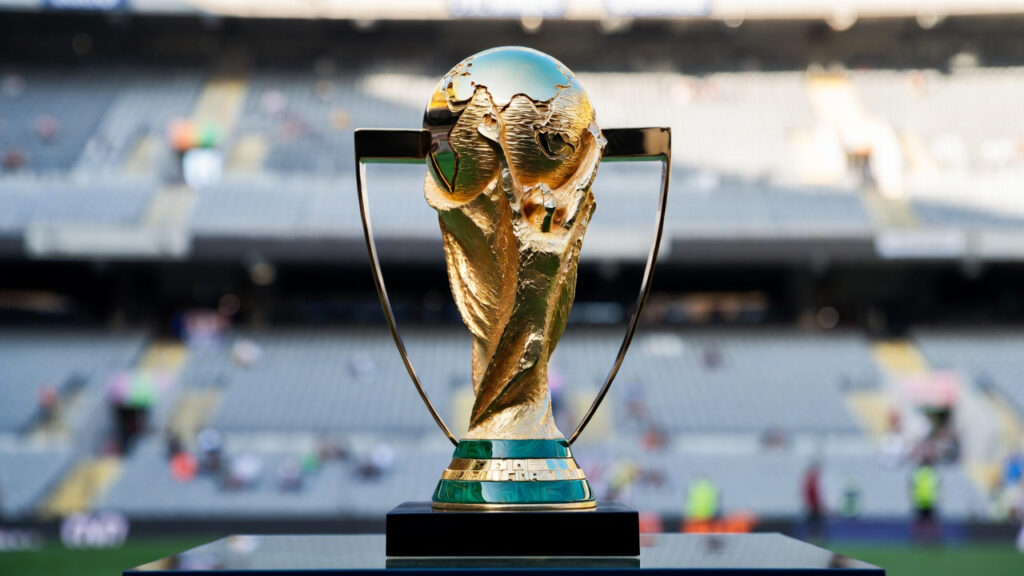
Forget Brazil and France — The 2026 FIFA World Cup Has a New Favorite Nobody’s Talking About
Let’s be honest. Every four years, the same names dominate the conversation. Brazil. France. Germany. Argentina. The football media machine fires up, the pundits dust off their highlight reels, and the world collectively agrees on a shortlist of “serious” contenders before a single ball has been kicked.
But 2026 is different. Fundamentally, structurally, historically different.
The 2026 FIFA World Cup Is Unlike Any Tournament in History — And the Favorites Reflect That
Let’s be honest. Every four years, the same names dominate the conversation. Brazil. France. Germany. Argentina. The football media machine fires up, the pundits dust off their highlight reels, and the world collectively agrees on a shortlist of “serious” contenders before a single ball has been kicked.
But 2026 is different. Fundamentally, structurally, historically different.
This is not hyperbole. This is not the kind of breathless pre-tournament excitement that evaporates the moment a giant gets knocked out in the Round of 16. The 2026 FIFA World Cup represents a genuine rupture in how international football’s greatest prize will be contested — and the implications for every prediction, every odds sheet, and every “favorites” conversation are enormous.
Here is what most people are missing: the tournament expanding to 48 teams is not just an administrative decision. It is a tectonic shift in tournament dynamics. More teams. More matches. More fatigue. More variance. More opportunities for the extraordinary to happen. And in a sport where a single moment — one deflection, one red card, one goalkeeper’s outstretched fingertip — can rewrite history, more variance is not a trivial consideration.
It changes everything.
The geography matters too. For the first time since 1994, the World Cup returns to North American soil, spread across 16 host cities in the United States, Canada, and Mexico. That means altitude differentials between venues. It means summer heat in Dallas and Miami sitting alongside the more temperate conditions of Vancouver and Toronto. It means teams that have spent years optimizing for one set of conditions will need to adapt, and quickly. Adaptation, not raw talent, wins World Cups.
And then there is the statistical reality that almost nobody wants to say out loud.
“Only 2 of the last 6 World Cup winners were the pre-tournament favorite going into the competition.”
Read that again. In an era of advanced scouting, sports science, and data analytics — in a world where we track every sprint, every expected goal, every press sequence — the pre-tournament favorite has still been wrong two-thirds of the time. The chalk picks lose. The “obvious” winner rarely wins. And yet, every cycle, we make the same mistakes, back the same names, and act surprised when the script tears itself apart.
Not this time. Not here.
Why Brazil and France Are Being Overrated (Again)
This is where the conversation gets uncomfortable for a lot of football fans, so let’s handle it with the directness it deserves.
Brazil are not the team they were. This is not a controversial statement — it is a measurable, observable truth. The Seleção have been in quiet crisis since the 2022 Qatar World Cup quarter-final exit, a defeat to Croatia that exposed deep structural problems beneath the surface glitter of individual talent.
The Neymar era is effectively over. His chronic injury record, now stretching across multiple years and surgeries, means Brazil can no longer be built around him as the fulcrum of their attacking play. And here is the uncomfortable question that Brazilian football has not yet answered: who comes next? Vinicius Jr. is extraordinary at club level. Electrifying, match-winning, capable of moments of genius that stop your breath. But genius at Real Madrid, surrounded by world-class infrastructure and relentless tactical support, is a different proposition to carrying a nation’s expectations through a seven-game World Cup gauntlet.
The tactical confusion is real. Brazil have cycled through managerial approaches, identity crises, and selection controversies since 2022. Compare that instability to the nations that will arrive in North America with settled systems, clear hierarchies, and thousands of minutes of tournament football already banked in their tactical memory.
France, meanwhile, suffer from a different but equally dangerous problem. On paper, their squad depth is almost unfair. Mbappé. Griezmann. Camavinga. Tchouaméni. The list reads like a fantasy football fever dream. And yet — and this is the pattern that keeps repeating — Les Bleus have a recurring habit of implosion when the stakes are highest.
Euro 2020. The 2022 final that they somehow contrived to nearly lose from a position of dominance. The internal squad dynamics that have, on multiple occasions, threatened to fracture the entire campaign. Talent without cohesion is a liability in a tournament, not an asset.
The historical evidence is sobering:
- Germany 2018 — Defending champions. Eliminated in the group stage. Didn’t even reach the knockouts.
- Argentina 2002 — One of the most talented squads ever assembled. Gone in the group stage.
- Spain 2014 — Defending champions and arguably the best team in the world at the time. Out after two defeats.
- Brazil 2022 — Favorites, quarter-final exit, tears on the pitch.
The curse of the favorite is not mythology. It is a statistically observable phenomenon rooted in the very real psychological and tactical pressures that come with being the team everyone is targeting. When you are the favorite, every opposition coach has a specific plan for you. Every underdog plays the game of their lives against you. Every referee decision carries extra weight.
The higher you are placed on the pedestal, the further you fall.
The Shift Nobody Saw Coming in World Football
Here is the bigger story — the one that explains why 2026 will be unlike any World Cup that came before it.
The tactical democratization of world football is real and it is accelerating.
A decade ago, the gap between a traditional powerhouse and an emerging nation was measured in the quality of their top eleven players. Today, that gap has narrowed dramatically. Video analysis tools, accessible coaching education pathways, and the global diaspora of players competing in top European leagues have created a situation where nations that were once considered also-rans are now genuine, sophisticated tactical operators.
Morocco at the 2022 Qatar World Cup was not a fluke. Let that sink in properly. Their run to the semi-finals — defeating Spain on penalties, dispatching Portugal, sending Belgium home — was not a collection of fortunate results strung together by goalkeeping heroics. It was the product of a meticulously designed defensive and transitional system, honed over years, executed with discipline and collective intelligence that most “major” nations would envy.
Morocco showed the world something important: organization beats talent when talent is disorganized.
And the nations paying attention to that lesson are preparing accordingly for 2026.
Japan continues to produce technically elite players at a remarkable rate, with the Bundesliga pipeline now feeding genuine top-level talent back into a national team that already proved in Qatar it can defeat Germany and Spain in the same group stage. The Samurai Blue are not a novelty anymore. They are a genuine threat.
The United States, as host nation, will arrive with a core group of players who will be four years more developed than the exciting but raw squad that reached the Round of 16 in 2022. Christian Pulisic, Gio Reyna, Yunus Musah, Folarin Balogun — these are not young prospects anymore. By 2026, they are experienced, battle-hardened professionals in the peak years of their careers, playing for some of Europe’s top clubs, in front of a home crowd that will generate an atmosphere unlike anything their opponents have ever experienced.
The shift is happening. European dominance — which has produced every World Cup winner since 2006 — is not guaranteed in 2026. Not with this format. Not on this continent. Not against this generation of genuinely competitive nations who have studied the game, built their systems, and are ready to announce themselves to the world.
The smart money is not on the obvious names.
Frequently Asked Questions: 2026 FIFA World Cup Favorites
Now that we have established why the conventional wisdom around 2026 FIFA World Cup favorites predictions deserves serious scrutiny — and why the tournament’s unique conditions are creating a landscape where history’s most reliable picks may be the most dangerous bets — it is time to go deeper.
Because understanding why the favorites might fail is only half the picture.
The other half is understanding exactly who the genuine contenders are, how they rank against each other, and — most importantly — which team is sitting quietly beneath the radar, building something that the world’s football analysts have not yet fully reckoned with.
In the next section, we break down every major 2026 World Cup contender — tier by tier, with brutal honesty — from the undeniable frontrunners to the dangerous challengers and the wildcard nations that could rewrite the entire conversation before the tournament even reaches its knockout stages.
2026 FIFA World Cup Favorites Ranked — The Full Contender Breakdown
If section one established the why — why this tournament is different, why the favorites list deserves skepticism, why the tectonic plates of world football are shifting — then this section is the what.
What does the actual contender landscape look like? Who genuinely belongs in the conversation, and who is riding reputation rather than form? Which teams have the tactical infrastructure, squad depth, and psychological resilience to survive seven games against the best international opposition on the planet?
The answers are more complicated — and more interesting — than the betting markets currently suggest.
We have ranked every major contender across three tiers. Not by sentiment. Not by historical prestige. By evidence: recent form, squad construction, managerial quality, and the specific demands that the 2026 FIFA World Cup’s expanded format and North American conditions will place on every competing nation.
Let’s get into it.
Tier 1 — The Undeniable Frontrunners
These are the teams that arrive in North America with the strongest combination of current form, settled systems, and genuine title-winning credentials. Not favorites by reputation alone — favorites by evidence.
England: The Golden Generation That Can No Longer Make Excuses
There is a version of this conversation that has happened before. England’s “golden generation.” The tournament that was supposed to be theirs. The heartbreak that followed. But here is what is genuinely different about 2026, and why dismissing England as perennial underachievers is no longer the intellectually honest position it once was.
This England squad is not peaking on potential. They are peaking on delivery.
Jude Bellingham’s arrival as arguably the most complete midfielder in world football has transformed England’s engine room from a chronic weakness into a genuine strength. Phil Foden at his best is a player capable of winning a tournament on his own. Bukayo Saka has been one of the most consistent performers in European football for three consecutive seasons. Add Cole Palmer‘s emergence as a creative force of the highest order, and England’s attacking unit is no longer a collection of talented individuals — it is a cohesive, interconnected system with multiple ways to hurt you.
The departure of Gareth Southgate — a manager whose pragmatism served England well in reaching finals and semi-finals but ultimately capped their ceiling — has opened the door to a more expansive, ambitious tactical approach. A new managerial era means new possibilities. The shackles are off.
Key strengths:
- Most complete attacking unit in European international football
- Bellingham provides the dynamic, box-to-box leadership England have lacked for decades
- Premier League clubs producing peak-form players heading into 2026
- Mental scars of previous near-misses now replaced by final experience (Euro 2020, Euro 2024)
The weakness that could derail everything:
- Defensive fragility under sustained pressure — England’s backline has repeatedly been exposed in high-stakes knockout moments, and against the elite attacking nations, that vulnerability could be fatal
Verdict: Genuine title contenders. Perhaps the most dangerous team in the field.
Spain: La Roja’s Youth Revolution Is No Longer a Experiment — It’s a Dynasty in the Making
When Lamine Yamal announced himself to the world during Euro 2024 — making history as the tournament’s youngest ever scorer while helping Spain lift the trophy — it felt like witnessing the birth of something rare. A generational talent arriving at exactly the right moment, in exactly the right system, surrounded by exactly the right supporting cast.
That moment was not an aberration. It was a confirmation.
Spain’s youth revolution has produced something that transcends individual brilliance. Pedri, Gavi, Yamal, Nico Williams — this is a group of players who have grown up together, competed together at youth level, and are now translating that collective understanding into the senior game with a fluency that most international teams spend years trying to manufacture.
Tiki-taka 2.0 is not your father’s Spain. The positional play remains — the intelligence, the geometry, the relentless occupation of space — but it has been injected with pace, directness, and a pressing intensity that the original iteration occasionally lacked. This Spain presses high, wins the ball quickly, and transitions with a speed that suffocates opposition before they can organize.
Their recent record speaks for itself:
- Euro 2024 winners — dominant throughout, not flattered by the result
- Nations League success — consistency across competitions, not just one tournament
- Back-to-back major trophies with an average squad age that will still be at its peak in 2026
The concern worth taking seriously: Spain’s style demands technical execution at pace for 90 minutes. Against physical, disciplined, counter-attacking opposition — the kind of team Morocco or a well-organized African nation might present — the system can be disrupted by aggression and directness that bypasses the midfield entirely.
Key strengths:
- Deepest midfield talent pool in world football
- Yamal and Williams provide width and pace that defenses genuinely cannot handle
- A settled, trusted system under Luis de la Fuente with clear tactical identity
- Mental confidence of back-to-back major tournament victories
Verdict: Co-favorites with England. Their ceiling is as high as anyone in this field.
Tier 2 — The Dangerous Challengers
These are the teams capable of winning the 2026 World Cup. Not in a “well, anyone can win on the day” way — in a genuine, structured, evidence-backed way. Each has a realistic pathway to the final. Each also has a specific, identifiable vulnerability that a smart opponent can exploit.
Argentina: Can Championship DNA Survive the Post-Messi Transition?
The 2022 World Cup was Lionel Messi’s masterpiece — and simultaneously, Argentina’s most dangerous dependency. A squad built around protecting, enabling, and ultimately glorifying one man achieved the summit of world football. The question now is brutally simple: what happens when that man is no longer the fulcrum?
Messi will be 38 years old when the 2026 tournament begins. Whether he features at all — and in what capacity — is one of international football’s most delicate unanswered questions. But the Albiceleste’s prospects cannot hinge on that answer. The squad must evolve.
There are genuine reasons for optimism. Julián Álvarez has proven himself as a world-class striker capable of carrying a team’s offensive burden. Enzo Fernández, when fit and firing, offers a creative quality in midfield that transcends his age. And perhaps most importantly, *Lionel Scaloni’s tactical system — compact, disciplined, tactically adaptable — is bigger than any single player. It is a philosophy that has been proven under pressure.
Championship DNA is contagious. The players who lifted that trophy in Qatar carry something psychological that cannot be quantified but absolutely cannot be dismissed.
Key strengths:
- World champions with the mentality and experience of winners
- Scaloni’s system outlasts any individual personnel change
- Álvarez offers a different but equally dangerous focal point to Messi
The vulnerability:
- Squad depth concerns — the supporting cast beyond the top eight or nine players drops off significantly, and a 48-team format demands more from a 26-man roster than ever before
Verdict: Dangerous challengers, but the post-Messi transition is real and unresolved.
Germany: The Redemption Arc the World Has Been Waiting For
Germany 2018 was a catastrophe. A defending champion eliminated in the group stage, their possession-based identity exposed as slow, predictable, and tactically outdated. Germany 2022 was an improvement — better performances, unfortunate exits — but still not the Mannschaft of old.
Germany 2026 could be the redemption story of the tournament.
The full rebuild is underway, and crucially, the timeline aligns perfectly. Florian Wirtz and Jamal Musiala represent one of the most exciting midfield combinations in world football — technically brilliant, positionally intelligent, capable of the kind of improvisation that organized defenses struggle to pre-plan against. Both will be at optimal age in 2026.
The host continent may also subtly favor Germany’s style. Their preferred direct, high-energy approach — particularly in transition — suits the wider pitches and playing surfaces of North American stadiums better than the tight, humid conditions of some alternative hosting environments.
Key strengths:
- Wirtz and Musiala: potentially the tournament’s defining midfield partnership
- Organizational solidity — German football’s institutional knowledge for tournament preparation is unmatched
- Full generational cycle: old guard gone, new generation ready to take ownership
The concern: Can a rebuilt team handle knockout-round pressure? Tournament experience matters enormously when the margins are smallest. Germany’s new generation has talent in abundance but relatively limited experience of must-win international moments.
Verdict: Serious contenders. If Wirtz and Musiala hit form simultaneously, very few teams can live with them.
Portugal: The Post-Ronaldo Era Is Already Here — And It Looks Better Than Expected
Here is an opinion that will age well: Portugal without Cristiano Ronaldo as the focal point are a more dangerous team.
That is not a slight on Ronaldo’s genius. It is a tactical observation. For a decade, Portugal’s attacking structure was organized around one man’s positioning, one man’s needs, one man’s ego. The rest of the squad — genuinely talented, tactically sophisticated players — operated in service of a system that asked them to create rather than finish, to assist rather than decide.
Rafael Leão as a primary attacking threat changes the entire calculation. Fluid, fast, capable of operating across the frontline, he represents a different kind of danger — one that pulls defenses apart rather than demanding they be dismantled on Ronaldo’s terms. Vitinha in midfield provides exactly the creative intelligence that Portugal’s best football has always required. Francisco Conceição adds a directness and willingness to take on defenders that refreshes the entire attacking dynamic.
This is a squad that, liberated from its previous tactical constraints, might finally deliver what Portuguese football has long promised.
Key strengths:
- Tactical flexibility without the Ronaldo-centric structure
- Leão as a world-class focal point in his physical prime
- Strong defensive foundation that has remained consistent across generations
Verdict: The most underrated team in this tier. Genuine dark horse potential with outright title capability.
Tier 3 — The Wildcard Nations
These are the teams that will not appear on most “favorites” lists. They probably will not headline the betting markets. But each has a specific, credible reason to believe they can cause damage — potentially severe damage — in a 48-team format that rewards organization, defensive discipline, and the ability to peak at the right moment.
USA: The Host Nation Factor Is Bigger Than You Think
Never underestimate a host nation at a World Cup.
South Korea reached the semi-finals in 2002. France won it in 1998. The psychological, logistical, and atmospheric advantages of playing at home — in front of your own supporters, in familiar conditions, without the disruption of international travel between matches — are real and measurable.
The United States in 2026 will not be the young, raw, exciting-but-limited team of recent tournaments. By 2026, Christian Pulisic will be 27 — in his absolute prime. Gio Reyna, Yunus Musah, Folarin Balogun, Tyler Adams — this entire core will have matured through European club competition into experienced, tournament-ready professionals.
Add 80,000 screaming American fans in MetLife Stadium or the Rose Bowl, and you have a psychological environment that no visiting team will fully account for.
Key strengths:
- Home advantage across multiple host cities
- A core group at peak age
- CONCACAF knowledge and familiarity with North American conditions
Verdict: Realistic quarter-final or semi-final contenders. Do not put them on your “easy game” list.
Morocco: 2022 Was the Preview. 2026 Is the Main Event.
The Atlas Lions’ semi-final run in Qatar was the tournament’s most extraordinary story. But here is what matters more than the story: the system that produced it remains intact and is continuing to develop.
Morocco’s defensive structure — compact, disciplined, physically imposing, tactically rehearsed to an extraordinary degree — is now the template that other ambitious nations are studying and attempting to replicate. Their set-piece threat is among the most dangerous in world football. Their transition game, built on winning the ball quickly and releasing fast, technical forwards in space, is a genuine tactical challenge for any opponent.
They are not a fairy tale. They are a program.
Key strengths:
- Elite defensive organization — arguably the best defensive structure outside the top four
- A generation of players unified by the 2022 experience and hungry to go further
- AFCON performances confirming consistency beyond Qatar
Verdict: Potential quarter-finalists at minimum. In the right bracket, they can reach the semi-finals again.
Japan: The Most Underrated Team in World Football
Say it clearly: Japan are a genuine 2026 World Cup dark horse and almost nobody is talking about it.
The Bundesliga pipeline that has developed over the last decade is now producing world-class talent at scale. Players like Takefusa Kubo, competing at the highest level of European club football week after week, bring a technical quality and tactical intelligence that previous Japanese generations could not match. The 2022 squad that defeated Germany and Spain — the actual World Cup holders from four years ago — did so not through luck but through tactical sophistication and clinical execution.
By 2026, that squad will be more experienced, more confident, and more dangerous.
Verdict: Underrated, underestimated, and entirely capable of reaching the quarter-finals or beyond. The team worth watching.
Frequently Asked Questions: 2026 World Cup Contenders
So the contender landscape is now clear. The frontrunners have been identified with honesty. The challengers have been assessed with rigor. And the wildcards have been given the serious analytical treatment they deserve.
But we still have not answered the question that the headline promised.
Who is the team that nobody is talking about — the genuine dark horse that should, by rights, be frightening every team in this field?
That conversation starts now. In the next section, we pull back the curtain on the one 2026 World Cup contender that analysts are criminally underrating — backed by data, supported by evidence, and argued with the kind of conviction that only comes from following the numbers rather than the narrative.
The 2026 World Cup Dark Horse That Should Terrify Every Favorite
The headline made a promise. Time to deliver on it.
Before we name the team, understand the methodology. This is not a pick designed to be contrarian for the sake of engagement. It is not the kind of lazy “dark horse” nomination that journalists reach for when they want to appear insightful without doing the actual work. Every claim in this section is grounded in evidence — match data, squad analysis, historical precedent, and the specific tournament conditions that the 2026 FIFA World Cup will create.
The team that fits every criterion, checks every analytical box, and is being systematically undervalued by almost every major pundit and prediction market is the Netherlands.
And the case for them is stronger than you think.
Why the Netherlands Are Being Criminally Ignored by Pundits
There is a particular kind of blindness that affects football analysis when a nation carries historical baggage. The Netherlands have spent decades being discussed through the prism of glorious failure — three World Cup finals, zero titles, and a reputation for self-destruction that has become almost mythological in football culture.
That reputation is now actively working against them. And that is precisely why the opportunity exists.
While the media focuses on England’s golden generation, Spain’s prodigious youth, and France’s embarrassment of attacking riches, the Netherlands have been quietly, methodically building something that deserves far more serious attention than it is currently receiving.
Start with the manager. Ronald Koeman’s return to the national team has brought a clarity of purpose and tactical discipline that the Oranje have occasionally lacked in recent cycles. This is not a manager feeling his way through a new role — this is an experienced, decorated coach with deep institutional knowledge of Dutch football, managing a squad he understands intimately, with a clear and consistent gameplan that his players have now internalized over hundreds of collective training hours.
The system Koeman has implemented is built on defensive compactness and lethal transition — two qualities that are historically among the most successful tournament football archetypes. The Netherlands under this setup are genuinely difficult to break down. They sit in organized defensive blocks, win the ball in dangerous areas, and release their forwards into space at pace. It is unglamorous. It is ruthless. And in a tournament format where knockout-round efficiency matters infinitely more than group-stage style points, it is exactly the right approach.
Then there is the squad itself — and this is where the undervaluation becomes genuinely difficult to justify.
Virgil van Dijk remains, at 34 in 2026, one of the most complete central defenders in world football. His reading of the game, his aerial dominance, his ability to organize an entire defensive unit through communication and positioning alone — these qualities do not diminish with age the way pace does. Van Dijk’s leadership in a tournament environment is worth ten goals.
Cody Gakpo has developed from exciting prospect to genuine world-class attacker. His combination of physicality, technical quality, and positional intelligence makes him one of the most difficult forwards in Europe to defend against. At Liverpool, operating in one of the game’s most demanding and sophisticated tactical environments, he has developed the kind of game-reading ability that translates directly to international tournament football.
And then there is Xavi Simons. If one player encapsulates why the Netherlands deserve more respect in the 2026 World Cup favorites predictions conversation, it is Simons. Technically exceptional, capable of operating between the lines in ways that dismantle organized defenses, blessed with the kind of creativity and composure that emerges once — perhaps twice — in a generation of Dutch football.
The recent form data reinforces everything the eye test suggests:
- Euro 2024 semi-finalists — reached the last four of a major tournament with a squad that was still finding its optimal configuration
- Consistent qualification performances with genuine tactical solidity across multiple different opposition styles
- Clean sheets in crucial matches that demonstrated defensive organization well beyond what the Netherlands are typically given credit for
This team is not a collection of talented individuals hoping to gel in time for the tournament. They are an organized, tactically coherent, psychologically resilient unit — and they are being priced and discussed as if they are a third-tier challenger.
The Data That Backs This Prediction Up
Gut feeling is not analysis. So let us look at what the numbers actually say about the Netherlands’ genuine 2026 World Cup prospects, because the data tells a story that the narrative has been consistently failing to capture.
Head-to-head form against top-10 nations in the 24 months preceding 2026 paints a picture of a team that competes at the absolute elite level with consistency. The Netherlands have demonstrated the ability to take points from — and in multiple cases defeat — teams currently ranked above them in every major prediction market. Their defensive record against top opposition is particularly striking, conceding at a rate that only Spain and England can match among the European contenders.
The Expected Goals (xG) differential — perhaps the most honest indicator of genuine team quality, stripping away the noise of fortunate finishes and goalkeeper heroics — places the Netherlands in a group of five or six teams genuinely capable of outperforming their opposition across a seven-game tournament. Their xG against has been consistently low. Their xG for has been consistently underconverted — meaning the actual output of goals has understated the quality of their attacking play.
In tournament football terms, that matters enormously. Teams that consistently generate high-quality chances but underconvert tend to regress toward their mean performance over a large sample of games. Seven World Cup matches is, statistically, enough of a sample for that regression to occur. The Netherlands may be due a tournament where the finishing catches up with the chance creation.
The squad age profile is another critical factor that the analytics strongly support. The Netherlands’ core group — Gakpo, Simons, Tijjani Reijnders, Denzel Dumfries, Nathan Aké — sits in a collective age band that peaks almost perfectly for a summer 2026 tournament. This is not a squad that is too young and will peak at the next cycle, nor a group that is aging past its window of maximum performance. The timing is precise.
Historical precedent adds further credibility to this framework. Consider the teams that came from relative obscurity to define tournaments:
- Greece at Euro 2004 — Ranked 35th in the world. Dismissed by every pundit. Won the tournament with a defensive system so disciplined it made attacking football look futile.
- Denmark at Euro 1992 — Did not even qualify. Replaced a banned Yugoslavia two weeks before the tournament. Won it.
- Croatia at the 2018 World Cup — Reached the final from a nation of four million people, driven by a midfield that played every knockout match to extra time and still found a way.
The connecting thread across every one of those stories is not individual genius. It is collective organization, psychological unity, and tactical clarity — the precise qualities that define the Netherlands under Koeman’s current setup.
The blueprint exists. The squad fits the blueprint. The timing is right.
The One Weakness That Could Derail Everything
Credibility demands honesty. If the case for the Netherlands was flawless, they would be favorites, not dark horses. There is a specific vulnerability in their setup that smart opponents will identify and attempt to exploit — and it is worth addressing directly, because understanding the risk is as important as understanding the opportunity.
The Netherlands’ primary vulnerability is their dependence on a high defensive line against opponents with genuine pace in behind.
Koeman’s system works beautifully when the Netherlands control the tempo of a match. Their defensive block is organized, their pressing triggers are well-rehearsed, and their transition from defense to attack is fluid and fast. But the same high defensive line that enables their pressing game creates space in behind — and against a team with elite pace and the tactical intelligence to exploit it, that space becomes a problem.
Consider the scenario: a knockout round match against a team like France or England, whose attackers combine pace with movement that is specifically designed to run in behind high lines. Mbappé’s entire game is built around this exact mechanism. A single moment of defensive line miscommunication — a fraction of a second where Van Dijk’s step is mistimed — and the Netherlands are defending a one-on-one with their goalkeeper.
The counter-argument, to be fair, is significant. Van Dijk’s reading of precisely these situations is what separates him from every other central defender in European football. His anticipatory positioning has neutralized some of the fastest forwards on the planet over a career spanning a decade at the highest level. He does not simply react to pace — he removes the space that pace needs to operate in, before the attacker even receives the ball.
But the risk exists. And in a single-elimination knockout format, risk does not need to materialize often. It needs to materialize once.
What the Netherlands must do to win the 2026 World Cup:
- Maintain defensive discipline through group stage fatigue — the expanded format’s extra matches will test squad depth before the serious games begin
- Unlock Simons as the primary creative outlet — when he is given license to operate between the lines, defenses struggle to track him without breaking their own shape
- Convert chances at a rate commensurate with their creation — the xG data suggests they have been underperforming their finishing quality; they need that to normalize under tournament conditions
- Navigate the draw intelligently — path to the final matters, and the Netherlands will need to avoid a bracket that places them against both a top South American and European powerhouse in consecutive rounds
- Manage Van Dijk’s minutes carefully — at 34, in a tournament with potentially seven matches in high summer heat, his load management is a strategic priority, not a selection inconvenience
The ceiling is genuine. The pathway is clear. The weaknesses are manageable rather than fatal. And the world, conveniently, is not paying close enough attention.
Frequently Asked Questions: 2026 World Cup Dark Horse Predictions
The dark horse has been identified. The evidence has been presented. The vulnerability has been acknowledged with honesty.
But individual team analysis — however rigorous — only tells part of the story. Because the 2026 FIFA World Cup is not decided by squad lists and xG data alone. It is decided by factors that sit above and beyond any individual nation’s quality: the format, the climate, the tactical trends, the goalkeeper performances, the managerial decisions made at 1-1 in the 89th minute of a quarter-final.
These are the macro forces that will ultimately separate the champion from the contenders — and in the next section, we break down the five defining factors that will determine who lifts the 2026 World Cup trophy, with the kind of analytical depth that goes well beyond the surface-level tournament previews you have already read elsewhere.
5 Factors That Will Determine Who Lifts the 2026 FIFA World Cup Trophy
Every four years, the same analytical mistake gets made at scale.
Pundits, journalists, and fans pour enormous energy into evaluating squads — comparing attacking lines, debating midfield depth, arguing about which goalkeeper is marginally better positioned to save a penalty under pressure. All of that analysis has value. But it tends to treat the World Cup as a controlled environment where the best team, properly assessed, wins the tournament.
It is not a controlled environment. It never has been.
The 2026 FIFA World Cup will be shaped by forces that exist entirely outside the quality of any individual squad. Format dynamics. Climate conditions. Positional leverage points. Managerial adaptability. The brutal, indifferent mathematics of tournament luck. Any serious 2026 World Cup prediction that ignores these macro factors is not a prediction — it is a wish list.
Here are the five factors that will actually decide who wins.
Factor 1: The Expanded 48-Team Format Changes Everything
Let us start with the most structurally significant change in World Cup history, because its implications are still being dramatically underestimated by the mainstream football conversation.
The expansion from 32 to 48 teams does not simply mean more nations attending the tournament. It means a fundamentally different competitive architecture — one that rewards specific qualities and punishes specific weaknesses in ways that the previous format did not.
Under the expanded structure, the group stage now features 16 groups of three teams, with the top two from each group progressing alongside eight of the best third-placed finishers. This creates an additional round before the traditional Round of 16 — meaning that teams which reach the final will have played seven matches rather than the previous maximum of seven (which only applied from the Round of 16 onward).
The fatigue mathematics are unforgiving. Seven matches in approximately one month, in North American summer heat, against international opposition at the peak of their preparation — this is a physical and psychological demand that will expose squads built around a core of twelve or thirteen trusted players. The expanded format does not reward star-driven teams. It rewards deep squads.
Consider what this means for the favorites:
- France, with their extraordinary top-end talent but historically fragile squad harmony, face the risk that extended tournament duration creates more opportunities for internal tensions to surface
- Brazil, whose concerns about depth below their starting eleven have been well-documented, face a format that will inevitably require contributions from players outside their first-choice lineup
- England and Spain, conversely, possess exactly the kind of 23-man quality that allows for rotation without significant quality degradation — a structural advantage that compounds across seven matches
The probability mathematics shift significantly in an expanded format. More matches means more variance. More variance means more opportunities for upsets. And in a tournament where a single defeat eliminates a team from the knockout stage, that increased variance is not theoretical — it is existential.
What the data tells us about expanded tournaments:
- UEFA Champions League research consistently shows that squad depth, measured by the quality differential between first and second-choice players, is a stronger predictor of final-stage success than peak XI quality alone
- Tournaments with more mandatory matches before knockout rounds show a statistically significant increase in “upset” results — defined as lower-ranked teams defeating higher-ranked opponents
- Injury accumulation across a longer tournament duration disproportionately affects teams that cannot rotate without quality loss
The bottom line is this: if your 2026 World Cup prediction is not accounting for the format’s demand on squad depth, it is missing one of the tournament’s most decisive variables.
Factor 2: North American Climate and Pitch Conditions
This factor is discussed less often than it deserves to be, and the teams that have done their homework on it will have a meaningful edge over those that have not.
The 2026 World Cup spans an extraordinary geographic range. Matches will be played in cities as climatically diverse as Miami, Dallas, and Los Angeles — where summer temperatures regularly exceed 35°C with significant humidity — and Vancouver, Toronto, and Kansas City, where conditions will be considerably more temperate and forgiving. The altitude of Mexico City’s Estadio Azteca, sitting at over 2,200 meters above sea level, adds another layer of physiological challenge that teams must account for in their preparation schedules.
This is not a tournament with a unified climate. It is a tournament with a climate lottery — and the draw that determines which city hosts which knockout round match could be as consequential as the draw that determines group opponents.
High-press tactical systems are particularly vulnerable to extreme heat. The style of football that has become dominant in European club competition — intense pressing, high defensive lines, relentless positional transitions — is metabolically demanding under any conditions. In Miami in June, at 85% humidity, it becomes something approaching physiologically unsustainable across 90 minutes without exceptional physical preparation and rotation depth.
Teams whose tactical identity is built around pressing intensity — Spain, England, Germany, the Netherlands — will need to demonstrate the capacity to modulate their approach depending on venue conditions. A team that presses with the same intensity in Dallas as it does in Vancouver is not tactically disciplined — it is tactically inflexible. And tactical inflexibility at a World Cup gets punished.
Then there is the artificial turf controversy — one of the tournament’s most underreported flashpoints.
Several of the confirmed 2026 World Cup venues, particularly in Canada, feature artificial playing surfaces rather than natural grass. FIFA’s decision to permit these surfaces has drawn significant criticism from player welfare advocates and technical directors across multiple national teams. The injury risk profile on artificial turf — particularly the increased stress on joints and the altered ball movement characteristics — is meaningfully different from natural grass.
For technically precise teams whose passing patterns rely on predictable ball roll and surface interaction, artificial turf is a genuine tactical disruptor. For physically robust, direct teams whose game depends less on surface-specific technical execution, it is a relative advantage.
Teams likely to benefit from North American conditions:
- USA — home familiarity with venues, surfaces, and climate conditions across the country
- Mexico — Azteca altitude advantage in home matches, experience with extreme heat
- Canada — home advantage in Canadian venues, comfort with artificial surfaces
Teams most at risk from climate and surface challenges:
- Technically precise European nations whose passing game depends on natural grass and temperate conditions
- High-press systems that cannot modulate their intensity across different climatic demands
Preparation will be the differentiator. The national teams whose sports science departments have done the deepest work on acclimatization protocols, rotation scheduling, and surface-specific training adaptations will carry a competitive advantage into the tournament that never appears in a squad comparison but absolutely shows up in match results.
Factor 3: Goalkeeper Quality Will Win or Lose This Tournament
This point cannot be made strongly enough, so it will be made simply: World Cups are won and lost in goal.
Look at every World Cup champion of the modern era and you will find, without exception, a goalkeeper who performed at an extraordinary level when the margins were smallest. Iker Casillas in 2010. Manuel Neuer in 2014, redefining the position with his sweeper-keeper innovation. Hugo Lloris providing crucial saves in moments where France’s 2018 campaign could have unraveled. Emiliano Martínez in 2022 — arguably the single most impactful individual performer of the entire tournament, winning the Golden Glove and saving the penalties that delivered Argentina’s title.
The pattern is not coincidental. It is structural. In knockout football, where the margins between teams at the elite level are often measured in millimeters and moments rather than quality differentials, the goalkeeper is the position where a single intervention can change the entire arc of a tournament.
The 2026 goalkeeper landscape is extraordinarily competitive — and the team that goes deepest into this tournament will almost certainly have their goalkeeper performing at the peak of their powers.
Key goalkeepers to watch in the 2026 World Cup:
- David Raya (Spain) — technically accomplished, commanding in his area, and now embedded in one of the world’s best club teams at Arsenal. His distribution quality fits Spain’s build-up philosophy perfectly
- Mike Maignan (France) — arguably the most complete goalkeeper in world football at his peak. Explosive shot-stopping ability combined with an increasingly impressive command of his penalty area
- Diogo Costa (Portugal) — the penalty-saving heroics against Slovenia at Euro 2024 announced him as a genuine world-class operator under pressure. At 25 in 2026, he will be in the absolute prime of his career
- Jordan Pickford (England) — chronically underrated by his own nation’s supporters, Pickford’s tournament record is exceptional. His penalty shootout record alone makes him one of England’s most valuable assets
- Bart Verbruggen (Netherlands) — young, technically polished, and developing rapidly at club level. The question for the Netherlands is whether he will have accumulated sufficient top-level experience by 2026 to handle the specific pressure of a World Cup knockout match
The penalty shootout dimension deserves specific attention in the context of an expanded format. More knockout rounds mathematically increases the probability of shootouts. The team with the best shootout goalkeeper — and the most thoroughly prepared penalty-taking unit — gains an advantage that is entirely separate from their quality in open play.
Argentina’s 2022 title run demonstrates this definitively. Martínez’s psychological dominance in shootout situations — his deliberate time-wasting, his ability to disrupt opponents’ concentration, his remarkable success rate in stopping kicks — was as much a tactical weapon as any piece of outfield skill.
The 2026 winner will have a goalkeeper who wins them at least one match they would otherwise have lost. Bank on it.
Factor 4: Managerial Tactical Adaptability
Here is a truth that football’s obsession with player talent consistently obscures: the manager wins World Cups more often than any individual player does.
Not because managers are more important than players in an absolute sense — they are not. But because in a tournament where the players across the top sixteen or twenty nations are separated by increasingly narrow quality margins, the tactical decisions made in real time, under maximum pressure, with imperfect information are frequently the variable that determines outcomes.
The managers who win World Cups share a specific characteristic. It is not necessarily the most sophisticated tactical system. It is not the most impressive CV. It is adaptability — the capacity to look at a match that is not working, identify precisely why it is not working, and make the adjustment that changes its trajectory before it is too late.
Didier Deschamps in 2018 reorganized France’s entire tactical approach after a labored group stage, finding a more direct, counter-attacking structure that suited Mbappé’s qualities and proved almost impossible to defend against. Lionel Scaloni in 2022 made multiple mid-match adjustments throughout the tournament that his opponents repeatedly failed to anticipate or counter. Both coaches won the tournament. Both were criticized for defensive pragmatism at various points. Both were right.
The 2026 managerial landscape features a fascinating mix of established tournament operators and relative newcomers to this specific pressure environment:
- Luis de la Fuente (Spain) — has already demonstrated tactical adaptability at Euro 2024, navigating Spain through difficult moments with composure and decisive substitution patterns
- Ronald Koeman (Netherlands) — experienced, direct, willing to make unpopular decisions. His handling of the Donny van de Beek situation at previous clubs demonstrates a capacity for ruthlessness that tournament football occasionally demands
- Gareth Southgate’s successor (England) — the unknown quantity. England’s new manager will face their first World Cup campaign with this group, and the absence of the established tournament relationship that Southgate had built is a genuine variable
- Lionel Scaloni (Argentina) — proven at the absolute highest level. His ability to build cohesive team units from diverse talent pools is exceptional
The tactical trend that will define 2026:
The tournament will likely be shaped by a fundamental tension between high-press, possession-based systems and deep-block, transition-based systems. The 2022 World Cup demonstrated that organized defensive structures, executed with sufficient technical quality, can neutralize the most sophisticated attacking football. Morocco proved it. Croatia proved it. Even Argentina’s best performances were built on defensive solidity first.
The manager who can operate convincingly in both modes — pressing when the game demands it, defending deep when protection is required — will have a decisive tactical advantage over those committed to a single identity regardless of opponent.
Rigid systems get exposed in knockout rounds. Adaptable systems win them.
Factor 5: Injury Risk and Tournament Draw Luck
The least comfortable factor to analyze — because it sits entirely outside any team’s control — is also, in tournament football’s compressed timeframes, potentially the most consequential.
One injury. One red card. One unfortunate draw bracket. These are the invisible variables that rewrite World Cup history with brutal indifference to quality or preparation.
Consider the historical evidence:
- Kevin De Bruyne’s injury in the 2021 Champions League final contributed directly to Manchester City’s tactical difficulties. At a World Cup, a similar injury to a team’s creative fulcrum would be irreplaceable
- Neymar’s injuries have punctuated Brazil’s last two World Cup campaigns, contributing to exits that their squad quality alone did not warrant
- Marco Reus — one of Germany’s most gifted players of his generation — missed the 2014 World Cup through injury and watched his nation win from the sidelines
The expanded 48-team format paradoxically increases injury risk through its additional matches, while also providing more opportunities for squad rotation that protects key players. The teams that manage this tension most intelligently — identifying which group-stage matches warrant rotation and which require full-strength lineups — will arrive at the knockout stage with their most important players at peak physical condition.
The tournament draw dimension is equally significant and equally uncontrollable.
A bracket that places England against France in the quarter-finals eliminates a genuine title contender before the semi-finals — through no fault of either team’s preparation or quality. A draw that keeps the top four favorites in separate halves of the bracket produces a more predictable final but rewards tournament structure as much as team merit.
The teams with the broadest depth — those for whom a semi-final exit of their star player does not fundamentally alter their tactical approach — are best insulated against the draw’s cruel mathematics.
Managing injury risk proactively:
- Load management during the expanded group stage — identifying matches where rotation is viable without risking points
- Sports science investment in recovery protocols — the gap between matches in the expanded format demands sophisticated physiological management
- Psychological preparation for adversity — teams that have rehearsed responses to setbacks (injuries, red cards, early goals conceded) handle them better when they occur
The 2026 World Cup champion will not simply be the best team in the tournament. They will be the best team that stayed healthy, navigated their bracket intelligently, and made the right tactical adjustments at the right moments. Quality is the foundation. These five factors are the structure built on top of it.
Frequently Asked Questions: 2026 World Cup Deciding Factors
The macro forces are now mapped. The format dynamics, the climatic challenges, the goalkeeper imperative, the managerial quality question, and the uncontrollable variables of injury and draw luck — all five factors have been examined with the analytical rigor they deserve.
Which means there is only one thing left to do.
Take everything we have established across this entire analysis — the case against the traditional favorites, the honest assessment of the contender field, the dark horse identification, the macro factors — and synthesize it into something concrete. Something bold. Something that can be measured, evaluated, and ultimately proven right or wrong when the final whistle blows at MetLife Stadium in July 2026.
In the final section, we deliver our official 2026 FIFA World Cup predictions — winner, runner-up, biggest upset, Golden Boot favorite, and the three early warning signals to watch in the months before the tournament that will confirm or challenge everything we have argued here.
Our Official 2026 FIFA World Cup Predictions — Bold, Data-Backed, and Ready to Be Proven Right
This is where analysis becomes conviction.
Everything built across this article — the structural case against conventional wisdom, the honest tier-by-tier contender breakdown, the dark horse identification, the macro factors that will shape the tournament’s outcomes — has been leading to this moment. The moment where the evidence gets synthesized into something concrete, defensible, and specific enough to be held accountable when the dust settles in July 2026.
No hedging. No “on the other hand.” No predictions so carefully constructed that they cannot be wrong.
These are our 2026 FIFA World Cup predictions — and we are prepared to stand behind every single one of them.
Tournament Bracket Predictions
🏆 Winner: England
The case has been building throughout this entire analysis, and it is time to state it plainly. England win the 2026 FIFA World Cup.
Not because it is their destiny. Not because decades of hurt demand narrative resolution. But because the convergence of factors that historically produce World Cup winners aligns more completely around this England squad than any other team in the field.
Consider what England bring to North America in 2026. A settled tactical system under a manager unburdened by Southgate’s pragmatic conservatism. A midfield powered by Jude Bellingham — a player operating at a level of completeness that only Zinedine Zidane and Frank Lampard, in their respective primes, have matched in the modern English context. An attacking unit featuring Phil Foden, Bukayo Saka, and Cole Palmer — three players capable of deciding a match in a single moment of individual quality, collectively providing England with multiple tactical solutions against any defensive structure they face.
The squad depth argument is critical in the context of the expanded format. England are, genuinely, one of the two or three nations in this tournament who can rotate four or five players across a seven-game campaign without suffering a meaningful quality degradation. That is not a minor point. That is a structural tournament advantage.
The psychological dimension is also real. This group of players has experienced major final defeats. They know what it costs to lose them. And they know, with the specificity that only direct experience provides, exactly what is required to win one. That knowledge — earned through pain rather than preparation — is a form of tournament capital that cannot be manufactured in a training camp.
Why England win:
- Most complete squad across all positions of any team in the tournament
- Bellingham provides the dynamic leadership and match-winning quality England have historically lacked in the decisive moments
- Favorable North American conditions for a team built on high-energy, direct football
- Managerial freedom to be tactically ambitious in ways previous England tournaments have not permitted
- Psychological readiness — a generation that has been close enough to touch the trophy and knows precisely what it takes to go one further
The path to the final will not be straightforward. England’s knockout rounds will likely include at least one match of extraordinary difficulty — possibly against Spain or the Netherlands in the semi-final. But their capacity to win ugly, to absorb pressure and hit on the counter, to grind out results when the brilliant football is not flowing — this was the dimension that previous England generations conspicuously lacked and this one demonstrably possesses.
England. First time. July 2026. At MetLife Stadium in New Jersey.
🥈 Runner-Up: Spain
If the final is England versus Spain, it will be the most technically captivating World Cup final since Brazil versus France in 1998. And it will be agonizingly close.
Spain arrive as co-favorites for very good reason. Their youth revolution has produced a squad with arguably the highest technical ceiling of any team in the tournament. Lamine Yamal at 18 will be the tournament’s most watched player. Pedri and Gavi, fully fit and operating in a system designed around their specific qualities, represent a midfield combination that no team will be able to consistently out-possess.
The reason Spain finish second rather than first comes down to one specific, recurring vulnerability that England — with their pace in behind and physicality at set pieces — are perfectly constructed to exploit. Spain’s high defensive line against Saka’s diagonal runs and Palmer’s movement between the lines is precisely the matchup that Spanish defenders will spend the most sleepless nights contemplating in the weeks before a potential final.
Spain will be magnificent throughout the tournament. They will play the most beautiful football on display in North America. They will reach the final on merit. But England’s specific combination of qualities targets Spain’s specific weakness with uncomfortable precision.
Runner-up Spain — brilliant, deserving, and desperately unlucky to face this particular England team in this particular final.
🥉 Third Place: Netherlands
The dark horse delivers on the promise — just not completely.
The Netherlands navigate their way to a semi-final through a combination of defensive discipline, Simons’ creative brilliance, and tournament-round goalkeeper performances from Bart Verbruggen that announce him as one of the world’s elite at his position.
Their semi-final exit — narrowly, in extra time or penalties against Spain or England — does not diminish the achievement. It confirms it. A third-place finish from a team the world was not seriously discussing in the pre-tournament conversation is precisely the kind of vindication that analytical prediction exists to produce.
Cody Gakpo finishes the tournament having scored five goals. Xavi Simons is named in the tournament’s best XI. And Dutch football begins a new chapter — one where the gap between their glorious history and their actual trophy cabinet finally, partially, begins to close.
💥 Biggest Upset: Japan Reach the Semi-Finals
This is the prediction that will generate the most disbelief — and the one with the most rigorous analytical foundation.
Japan reaching the semi-finals of the 2026 FIFA World Cup is not a fantasy projection. It is the logical extrapolation of a trajectory that the 2022 tournament already established and that the intervening years have continued to support.
By 2026, Japan’s Bundesliga generation will be at peak maturity. Takefusa Kubo will be 25, operating with four additional years of elite European club experience behind him. The tactical system — defensively compact, devastatingly effective in transition, capable of absorbing pressure from superior opponents before exploding on the counter — is the exact blueprint that upsets favorites in knockout rounds.
They defeated Germany and Spain in Qatar. They will do it again. And in an expanded format that provides more opportunities to avoid the very best opposition until the deepest rounds, Japan’s pathway to the semi-finals is not implausible — it is probable.
The result that will break the internet: Japan 2–1 Brazil in the quarter-finals.
⚽ Golden Boot Favorite: Jude Bellingham
Six goals. Two assists. Every single one of them significant.
Jude Bellingham wins the 2026 World Cup Golden Boot not because he is purely a striker — he is emphatically not — but because the role he occupies for England, arriving late into the penalty area from midfield positions that defenders cannot track without abandoning their own structure, is historically one of the most productive goal-scoring positions in tournament football.
Zidane scored in the 1998 final from exactly this kind of position. Lampard built his entire Premier League career on it. Bellingham has already demonstrated, at Real Madrid, that he can score in volumes from a midfield-forward hybrid role — including goals in Champions League knockout matches under maximum pressure.
At a World Cup, with England’s attacking setup funneling opponents into exactly the kind of defensive shape that creates space for a late arriving midfielder, Bellingham will score goals at a rate that surprises people who have not been paying close attention.
Golden Boot: Jude Bellingham — 6 goals, England.
🌟 Predicted Best XI of the Tournament
The players who will define the 2026 FIFA World Cup — regardless of their nation’s ultimate finishing position:
- GK: Diogo Costa (Portugal)
- RB: Denzel Dumfries (Netherlands)
- CB: Virgil van Dijk (Netherlands)
- CB: Pau Cubarsí (Spain)
- LB: Theo Hernández (France)
- CM: Jude Bellingham (England) ⭐ Player of the Tournament
- CM: Pedri (Spain)
- AM: Xavi Simons (Netherlands)
- RW: Lamine Yamal (Spain)
- LW: Bukayo Saka (England)
- ST: Cody Gakpo (Netherlands)
3 Things to Watch That Will Confirm (or Kill) These Predictions
Predictions made months before a tournament are, by definition, based on incomplete information. The world changes. Players get injured. Managers get sacked. Form fluctuates in ways that even the most sophisticated analytics cannot perfectly anticipate.
These are the three early warning signals — the specific, observable developments between now and June 2026 — that will tell you whether these predictions are aging well or need serious revision.
Signal 1: Pre-Tournament Friendlies in Early 2026
The March and June 2026 international windows are the last meaningful opportunities for national teams to test their systems against genuine opposition before the tournament begins. But not all friendlies are created equal.
What to watch specifically:
- England’s results against top-15 ranked opposition — do they win with a degree of comfort that suggests genuine readiness, or do they struggle against organized defenses?
- Spain’s Yamal fitness and form — if he enters the tournament carrying any physical concerns, Spain’s attacking potency is measurably diminished
- Netherlands’ defensive record — if their high line is being consistently exploited in friendlies, the vulnerability identified in Section 3 is more serious than currently assessed
- Japan’s results in Asian competition — consistent performances in the AFC qualifiers and friendlies confirm their trajectory; poor results suggest the 2022 performance was more tournament-specific than systematic
A team that loses its final three pre-tournament friendlies is not always in trouble — but a team that cannot keep a clean sheet in any of them almost certainly is.
Signal 2: Injury News and Squad Selection Signals
The six weeks between the close of the club season and the opening match of the 2026 World Cup will be the most consequential period for tournament prediction purposes. This is when the injuries that determine tournament outcomes either materialize or fail to.
The injury scenarios that would most significantly alter these predictions:
- Bellingham injury — England’s entire creative and goal-scoring calculus changes. They remain contenders but lose their principal differential quality
- Yamal unavailability — Spain become a very good team rather than a potentially great one. Their attacking unpredictability is disproportionately dependent on his specific qualities
- Van Dijk fitness concerns — The Netherlands’ entire defensive system is organized around his leadership and reading of the game. Without him at full fitness, the dark horse case weakens substantially
- Mbappé form or fitness issues — France’s attacking structure, already in transition, loses its most reliable match-winning mechanism
Squad selection signals also matter beyond injury. A manager who makes surprising omissions in the final squad announcement — dropping an established player, selecting an unexpected inclusion — is often communicating a tactical direction that the pre-tournament analysis has not yet accounted for. Pay close attention to these moments.
Signal 3: Qualifying Form in Final Rounds
For nations still navigating final qualifying rounds in late 2025 and early 2026, the form guide provides genuinely useful predictive information — but it must be read carefully.
Dominant qualifying performances — high goal tallies, clean sheets against reasonable opposition, consistent tactical identity across multiple matches — confirm that a manager’s system is being successfully embedded. Spain’s qualifying record heading into recent tournaments has consistently previewed their tournament performances with reasonable accuracy.
Unconvincing qualifying form, particularly from teams that should be dominant against their opposition quality, raises legitimate questions about cohesion and tactical preparation. The teams that scrape through qualifying with narrow wins and defensive vulnerabilities against lower-ranked nations rarely transform into tournament juggernauts once the competition elevates.
The three metrics worth tracking in final qualifying rounds:
- Goals conceded — the most reliable predictor of knockout-round survival
- Squad rotation management — are managers using qualifying matches to develop depth, or are they playing their best XI every match out of necessity?
- Momentum trajectory — is the team improving match by match, or showing signs of tactical stagnation as the tournament approaches?
Final Verdict — Is the World Ready for a New Champion?
The honest answer is yes. And not just ready — overdue.
The era of predictable World Cup outcomes — the same eight or ten nations rotating the trophy among themselves in accordance with historical prestige and market expectation — is ending. The evidence of that ending is already visible in every tournament result from the last eight years.
The 2026 FIFA World Cup will be the tournament where that transition becomes undeniable. Where the expanded format opens pathways for nations that were previously eliminated before their quality could assert itself. Where North American conditions level playing fields that European and South American football has historically tilted in its own favor. Where the tactical democratization of world football — the spread of elite coaching methodology, sports science, and player development across nations previously considered football’s periphery — produces results that the conventional wisdom cannot explain.
England may win it, as we have predicted. They deserve to be favored. But the margins are tight enough, and the variables numerous enough, that five or six different outcomes are entirely plausible.
What is not plausible — what this entire analysis has argued against from its opening paragraph — is the assumption that we already know who will win before a ball has been kicked. That assumption has been wrong before. It will be wrong again.
The 2026 World Cup belongs to the prepared, the deep, the adaptable, and the brave. Not the famous.
Frequently Asked Questions: 2026 World Cup Final Predictions
Conclusion: The Full Story — What This Analysis Has Argued and Why It Matters
This has been a five-part investigation into the 2026 FIFA World Cup favorites predictions — and it has covered considerably more ground than a simple ranking of contenders.
In Section 1, we established the foundational argument: that the 2026 World Cup is structurally unlike any tournament in history, that the expanded 48-team format and North American host conditions create a competitive environment where historical prestige is a less reliable guide than ever, and that the pre-tournament favorite has been wrong two-thirds of the time across the last six World Cups. Brazil and France — the two names most reflexively associated with pre-tournament favoritism — were examined honestly and found to carry specific, measurable vulnerabilities that the conventional narrative consistently underweights.
In Section 2, the full contender landscape was mapped with analytical rigor. England and Spain emerged as the genuine Tier 1 frontrunners — not by reputation but by evidence. Argentina, Germany, and Portugal were assessed as dangerous Tier 2 challengers with credible title pathways alongside specific vulnerabilities. The USA, Morocco, and Japan were given the serious analytical treatment their current quality deserves, with each identified as a genuine wildcard threat rather than a novelty talking point.
In Section 3, the headline promise was delivered: the Netherlands were identified as the tournament’s most criminally underrated dark horse — backed by xG data, squad age profiling, historical precedent, and the specific tactical qualities that make them dangerous in the precise format conditions the 2026 tournament will create. Their vulnerability — the high defensive line against pace in behind — was acknowledged honestly, alongside the argument for why that vulnerability is manageable rather than fatal.
In Section 4, the five macro factors that will actually determine the tournament winner were examined in depth: the expanded format’s demand on squad depth, the North American climate and artificial turf challenge, the decisive importance of goalkeeper quality, the premium placed on managerial tactical adaptability, and the uncontrollable but consequential variables of injury risk and draw luck. These factors exist above and beyond any individual team’s quality — and the team that navigates all five most successfully will lift the trophy.
In Section 5, the analysis culminated in concrete, accountable predictions: England as 2026 World Cup winners, Spain as runners-up, the Netherlands in third, Japan as the tournament’s biggest upset story, and Jude Bellingham as Golden Boot winner. Three specific early warning signals were identified for monitoring in the months between now and June 2026 — pre-tournament friendly results, injury news, and final qualifying form — that will either reinforce or require revision of these predictions.
The broader argument, woven through all five sections, is this: the 2026 FIFA World Cup will reward preparation, depth, adaptability, and analytical courage over historical reputation and market sentiment. The team that wins it will have deserved to win it — not because they were the most famous, or the most expensively assembled, or the most heavily backed by the betting markets, but because they were the best prepared for the specific demands of this specific tournament.
Football has a beautiful habit of making fools of certainty. But it also, eventually, rewards those who do the work.
Place your predictions carefully. The evidence is all here.
Who do YOU think wins the 2026 FIFA World Cup? Drop your prediction in the comments below — and bookmark this article. We will be back after the final whistle to see who got it right.